When I am Among Friends I am Least Disabled, by Martin Hobgen
'A book to be read by those working in disability theology as a discipline, but also holds important insights for church congregations and pastors as a whole'
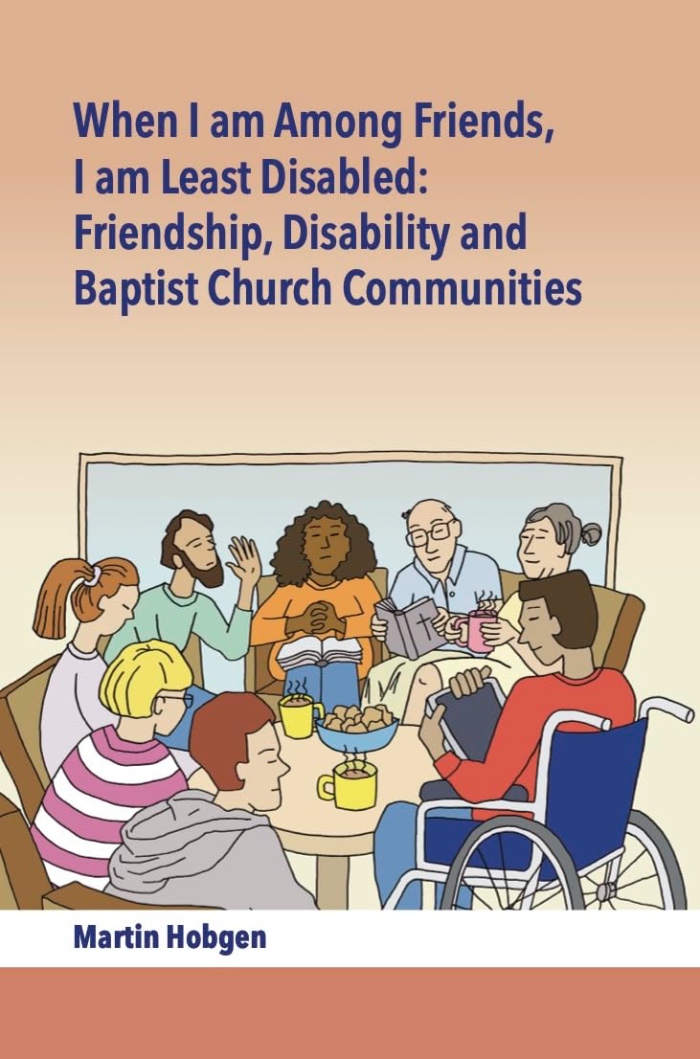 When I am Among Friends, I am Least Disabled: Friendship, Disability and the Baptist Church Communities
By Martin Hobgen
ISBN: 979-8248994731
Centre for Baptist Studies, Regent’s Park College, Oxford
Reviewed by David Mclachlan
With this book, Martin Hobgen brings to a wider audience his doctoral work and contributes a very useful next step in the development of disability theology literature. The book is rooted in Hobgen’s own experiences as a wheelchair user, and as someone who has gone through Baptist ministerial training and then worked as a Baptist pastor. This makes it particularly pertinent reading within the Baptist ecclesial family, but it should also inform the church more widely when considering what Hobgen calls the participatory inclusion of disabled people in Christian fellowships and leadership.
The argument of the book, however, goes much deeper than questions of Baptist leadership. It concerns how we understand the relationships among and between non-disabled and disabled people. As the title suggests, the key to this lies somewhere in our idea of friendship.
However, Hobgen does not just identify friendship as an aspirational good. He explores how such relationships are shaped by language (drawing on Sally McFague’s work on metaphor), and by our fundamental understanding of God as Trinity, specifically as “persons as relations” (drawing on Paul Fiddes’ work on the Trinity). The question is what we can legitimately transpose from our understanding of relationships within the Trinity to relationships among people.
Hobgen wisely holds these discussions up against a specific (Baptist) ecclesiology (as well as his own lived experience), which avoids any conclusions becoming too generalised. The work is also placed helpfully in the context of contemporary sociological and theological understandings of disability, such as the social model and work by the likes of Nancy Eiesland and Hans Reinders. (Reinders in particular also explores ideas of friendship, but addressing the rather different question of what it means to be made in the image of God.)
The great triumph of this book is that after such deep work, the conclusions are extremely practical and readily grasped. Hobgen concludes that the friendships that promote participatory inclusion are those that are intentional, mutual, and particular. Much lies behind each of those three words, but they are concepts that Christians and local churches can readily work with.
This is definitely a book to be read by those working in disability theology as a discipline. But it also holds important insights for church congregations and pastors as a whole. Some of the discussion in the middle sections of the book might be a bit challenging, but they are nonetheless rewarding and happily the conclusions do not depend on following every nuance of how the book gets there!
The Revd Dr David McLachlan is a Baptist minister and until recently a tutor in Christian doctrine at Spurgeons College. He is author of the book Accessible Atonement: Disability Theology and the Cross of Christ and is a member of the Baptist Union Disability Justice Hub
Baptist Times, 08/05/2026