Friendship, disability and the Baptist Church
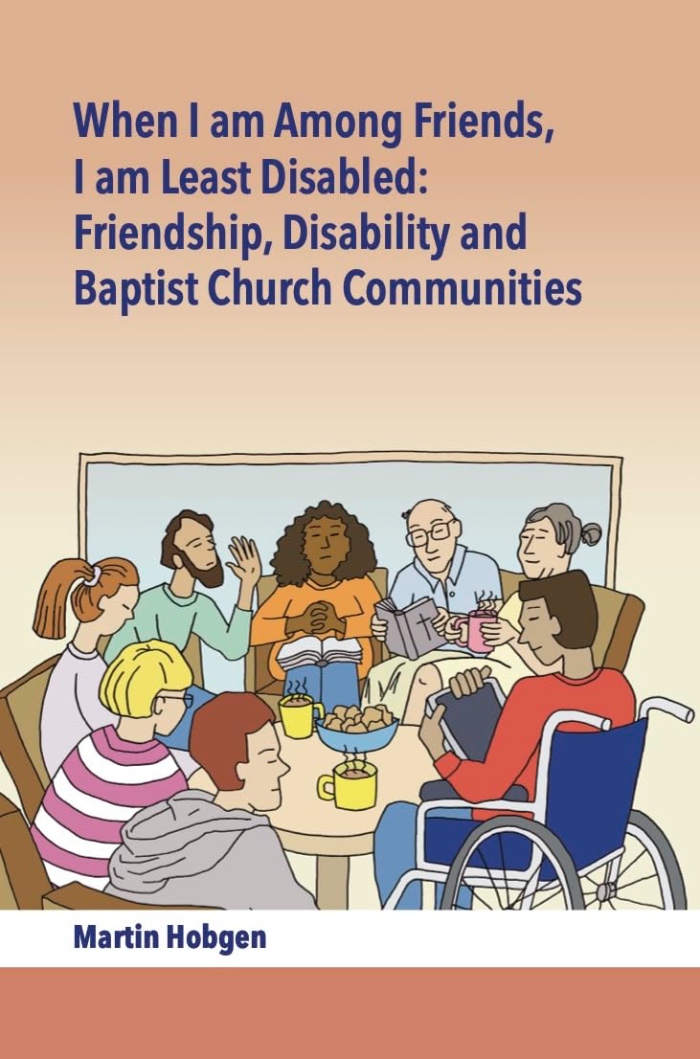
How can the fostering of friendships between disabled and non-disabled people enable participatory inclusion within Baptist Church communities? Baptist minister Martin Hobgen, who is also a full-time wheelchair user, explores the motivation and significant themes of his recently published book When I am Among Friends I am Least Disabled.
Martin explains the title could be expanded to reflect the alternative experience, ‘When I am among strangers I am most disabled.’
 When I became a Christian, aged 19 while studying Maths & Computing at Bath University, I was welcomed into the life of the Christian Union and one of the local Anglican churches, St Swithun’s, Walcot Street. I quickly became involved in the worship groups, both in the CU meetings and at church, where I was also involved in prayer ministry after some of the services.
Despite being a full-time wheelchair user, I was not surprised by this experience, having attended mainstream education throughout my schooling. I’d had no experience of churches while growing up, other than occasional attendance at a local church when my sisters were attending parade services with Brownies or Guides. My experience of participatory inclusion in several different church communities continued once I had graduated, culminating in a call to Baptist ministry in the mid-1990s.
It was only when I attended Bristol Baptist College and discovered the emerging field of disability theology that I discovered that my experiences were at odds with those of the majority of disabled people. An MA dissertation exploring sociological models of disability and church response followed, before I spent 12 years in pastorate while the ideas for further research slowly formed in my mind. A successful PhD thesis followed and this book is an edited version of that thesis.
My initial research explored both the sociological and theological understandings of disability that had emerged since my earlier MA thesis. Reflecting on this growing body of work and on my own experiences, I realised that one of the key factors in my experience of participatory inclusion was my friendships with non-disabled people, leading to my inclusion in common activities within the life of the church. To my surprise I found that friendship was a theme that was almost absent from both the sociology of disability and from the range of emerging theologies of disability.
This led to the research question at the heart of this book: How can the fostering of friendships between disabled and non-disabled people enable participatory inclusion within Baptist Church communities? This is covered in the prologue, introduction and chapter 1.
This book explores some of the barriers that can inhibit disabled and non-disabled from forming friendships that can foster participatory inclusion. These include the language used regarding disability, particularly when disability is used as a negative metaphor, the uncritical adoption of unhelpful sociologies of disability which focus on individuals in isolation, and the need to be aware of the limitations and potential of a range of theological understandings of disability, some of which inhibit inclusion while others seek equality before God. This material is covered in chapters 2, 3 and 4.
As a Baptist minister, with my research partially supported by the Baptist Union Further Studies fund, the context is primarily within Baptist church communities. The covenantal, relational nature of the local church is therefore a key element in exploring the significant of friendships that foster inclusion.
Alongside this is the use of Paul Fiddes’ relational understanding of the Trinity. This focuses on the relationship between the three persons rather than the characteristics of each. There emerges a powerful analogy between this understanding and the concept that it is the relationships between disabled and non-disabled people that is key, rather than the characteristics of disabled people contrasted with the characteristics of non-disabled people.
This analogy helps address two unhelpful understandings of disability. A historical sociological understanding of disability has focussed on an individual’s medical condition, while some theological understandings have either assumed sin is at the root of disability or that a disabled embodiment needs to be physically healed. This theme is developed in chapter 5.
Finally, a concept of friendship emerges that is intentionally inclusive, focusses on genuine mutuality between disabled and non-disabled participants, and takes into account the particularity of the context of that friendship. This form of friendship is explored in relation to the range of disability theologies examined earlier and engages with Fiddes’ relational understanding of the trinity.
A recurrent theme is that of participation. Disabled people are often present in church congregations, if there are no physical barriers to prevent them. However, they are often assumed to be passive with a pastoral care relationship adopted by the rest of the congregation. It is hoped that the reader will gain a better understanding of the nature of disability and the issues raised by the various sociological and theological understandings of disability.
Furthermore, they will better understand the power of genuine friendships between disabled and non-disabled people that can foster the participatory inclusion of disabled people in all aspects of Baptist church communities, regionally within Associations and nationally in Baptists Together and beyond.
When I am Among Friends, I am Least Disabled: Friendship, Disability and the Baptist Church Communities by Martin Hobgen is available here
The book is the latest from the Centre for Baptist Studies, Regent’s Park College, Oxford.
Do you have a view? Share your thoughts via our contact form
Baptist Times, 16/04/2026