'The war continues... and our moral and Christian obligation continues'
Four years on, Joshua T. Searle offers this reflection on the ministry of Dnipro Hope Mission amid the Russian-Ukrainian war
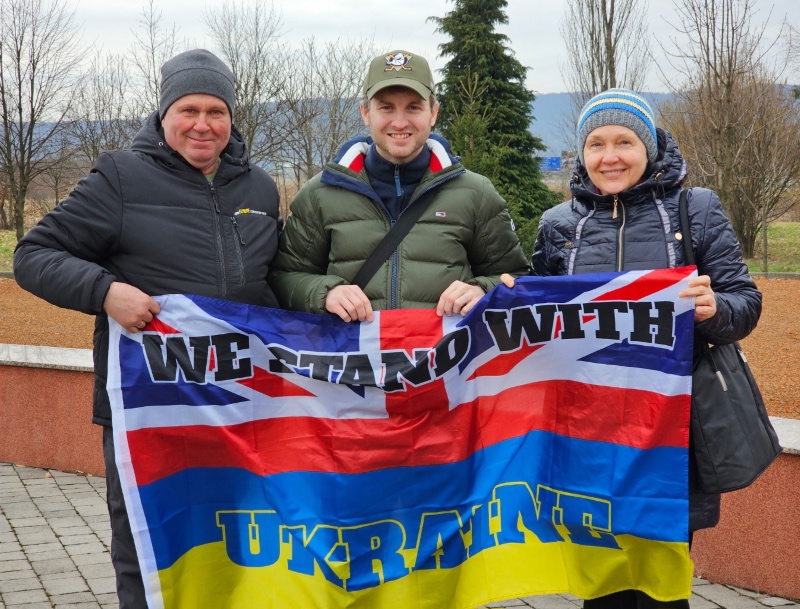
Four years ago this week, we woke up to images that seemed to belong to another century: columns of tanks rolling across borders, missiles streaking through dawn skies, parents and small children crowding into metro stations and improvised bomb shelters. The Russian invasion of Ukraine on 24 February 2022 shattered our comfortable assumptions about the post-Cold War order. We had complacently assumed that the arc of history was bending inevitably toward peace and the permanence of international norms. We had allowed ourselves to believe that large-scale conventional warfare in Europe was a thing of the past, something our grandparents endured but that we had evolved beyond.
On that fateful day in February 2022, we were proved wrong.
For those of us involved with Dnipro Hope Mission, the war did not come as a complete surprise. Since 2014 and the illegal annexation of Crimea and the covert Russian invasion of the Donbas, I had been watching the tragedy unfold from the inside. After leaving my mission work in Donetsk in order to return to the UK in 2013, I remained in close contact with my Ukrainian friends and family, as well as travelling to Ukraine regularly.
I had already seen what Russia was doing in Ukraine and had developed a deep admiration for how the Ukrainian people had shown their courage, skill and determination in the face of such a ruthless foe. Therefore, the vehemence of Ukrainian resistance in 2022 did not surprise me, because I had already witnessed at first hand the resilience of the Ukrainians I am privileged to call my friends.
But I can’t claim to have foreseen the scale of what was to come, including the magnitude of suffering, the breadth of destruction and the depth of evil unleashed. It has tested me and my fellow DHM-trustees and Ukrainian ministry partners in ways we could not have imagined.
As I have followed the tragic course of events since the Russian invasion, I have found myself constantly asking the following question: In the face of such overwhelming violence and destruction, what is the appropriate Christian response?
As I have wrestled with this question, I realise that while I understand the necessity of resisting Russia with armed force, I have found there is another form of resistance that also makes a material difference to the realities on the ground in Ukraine: humanitarian action and compassionate Christian ministry.
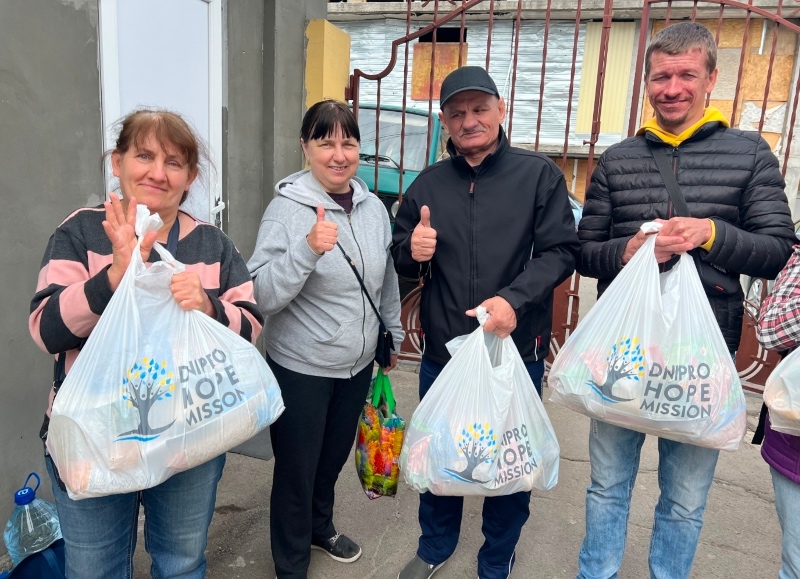
At DHM we are guided by our conviction that Christians should engage in humanitarian action to alleviate suffering and uphold the sanctity of life and the dignity of all people. This is the work that Dnipro Hope Mission and other Christian organisations have undertaken in Ukraine. Resistance to evil takes the form of delivering food, water and medicine to vulnerable and suffering people, as well as providing shelter for displaced persons. Upholding dignity is also a form of implicit resistance to the brutality of war, which is why DHM offers medical care, particularly to vulnerable people including the elderly, disabled and children.
This humanitarian work is, I maintain, itself a form of peacemaking. By preserving life and alleviating suffering, DHM is helping to defy the dehumanising logic of war in a way that witnesses to the dignity and sanctity of every human person. Moreover, it creates space for healing and reconciliation by building relationships of trust and care that can survive the trauma of war.
When Russian missiles destroy a power station in the dead of winter, leaving thousands without heat or light, DHM’s provision of generators and warm clothing is an act of resistance. Even though our modest efforts cannot compensate for the loss of critical infrastructure, we are able to help and serve countless people by offering them somewhere warm to stay and giving them a simple supply of food, water and medicines. When Russian artillery shells a village, forcing families to flee with nothing but the clothes on their backs, DHM’s provision of shelter and food is an act of resistance.
When Russian terror seeks to break the spirit of the Ukrainian people, DHM's presence – consistent, compassionate, committed – is also an act of resistance.
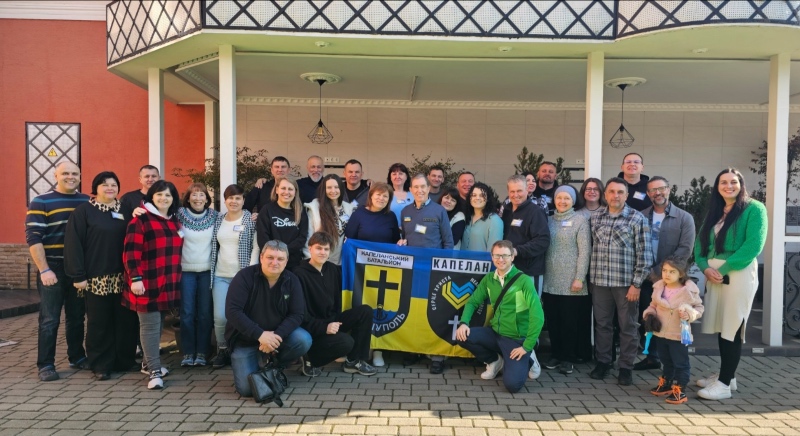
This is not neutrality. This is not “staying out of politics.” This is taking sides with the oppressed against the oppressor. As Christians, we must not shy away from taking sides with life against death or with hope against despair. This kind of humanitarian work I would argue is, in the deepest sense, a political act, but not in the usual sense of party politics or ideology. It is the politics of the Kingdom of God, which stands in judgment over all earthly kingdoms and their pretensions, and witnesses to a better way.
The expansion of Dnipro Hope Mission over the past four years has been remarkable. What began as a focused ministry in the small town of Vasylkyvka in the Eastern Dnipro region has grown into a lifeline for hundreds of thousands across eastern and central Ukraine, extending out even as far as Kyiv and Lviv.
Since 2022, DHM has been able to directly help an estimated 512,000 Ukrainian people with life-saving and life-enhancing assistance, such as food, clean water and essential medical supplies. Let that number sink in: half a million people. Half a million individuals, each with a name, a story, a family, and a future, who received tangible help in their darkest hour.
This did not happen by accident; nor did it happen as a result of any great strategy or ingenuity on the part of any individual. It happened, rather, because of the grace of God, aided through the generous and sacrificial donations of individuals and churches, who caught our vision and helped us to help our friends in frontline ministry in Ukraine.
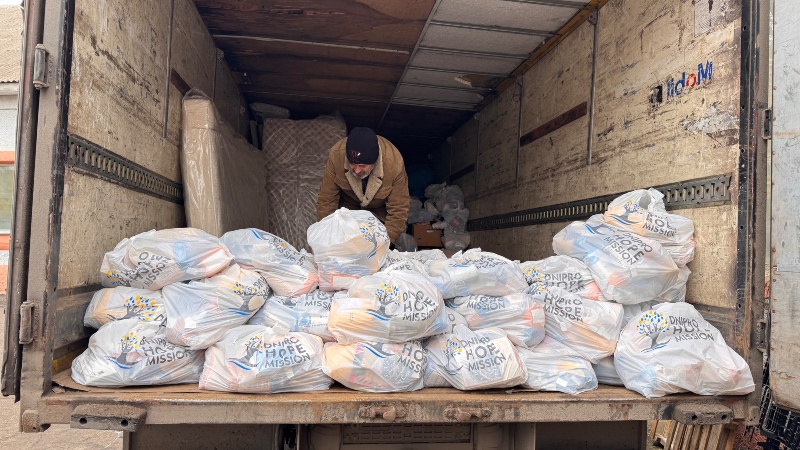
Since 2022 the contributions of DHM have been recognised with various accolades by the local Dnipro authorities, which further testifies to the quality and impact of our work. But more important than any official recognition is the testimony of those who have been helped: the countless elderly women who received food parcels from DHM when their pensions could no longer buy bread; the young children and their parents who received hospitality in a warm hub in one of our partner churches, after the Russians blew up the local power station, thereby cutting off the heating to their flat during a period when the temperatures regularly dropped to -20 degrees; the countless families who found a temporary refuge in a warm shelter in one of our hospitality centres when their own homes were reduced to rubble.
These are not statistics. These are lives. These people are not abstract objects of our charity, but they are the image-bearers of God, persons loved by Him, valued by Him and served by His people through the heroic ministry of the local partners that DHM supports.
Yet four years into this war, there is a danger that the watching world will grow weary. Ukraine is now rarely the lead story on the evening news. The initial surge of solidarity and support has ebbed. Other crises compete for attention and resources. There is a temptation to assume that the situation has reached some kind of equilibrium, that the acute emergency has passed, and that we can move on.
Yet this would be a catastrophic mistake. The war continues. The suffering continues. The need continues. And our moral and Christian obligation continues.
Theologically, our commitment to Ukraine is rooted in several core convictions: First, the imago Dei, which teaches us that every human being is made in the image of God and possesses inherent dignity and worth. When that dignity is violated (be it through violence, displacement, or deprivation) we who bear the name of Christ are called to respond. To turn away from suffering is to turn away from the One who suffers with the displaced and deprived.
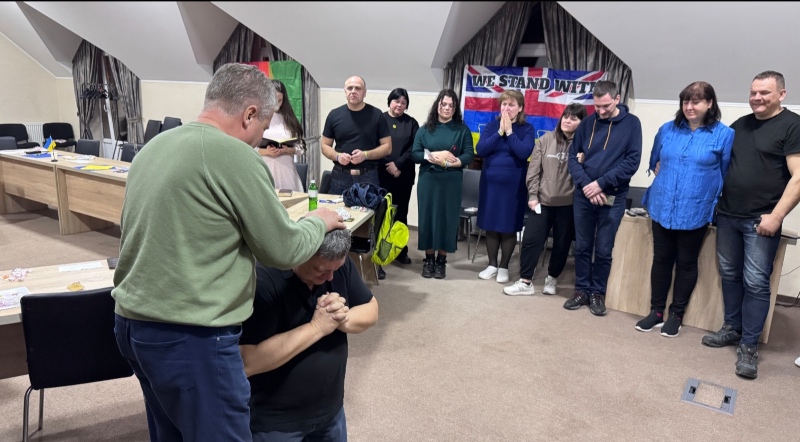
Secondly, we are guided by our belief in God’s preferential option for the vulnerable. Throughout Scripture, God’s heart is consistently revealed as being with the poor, the widow, the orphan, the stranger, the oppressed and the persecuted. The prophets thunder against those who neglect the vulnerable; Jesus identifies Himself in Matthew 25 (a foundational scripture for DHM) with “the least of these.” In Ukraine, the most vulnerable, the elderly, the disabled, children, those trapped in conflict zones, are bearing the brunt of this war. In this context our calling is clear; we can’t remain silent.
Thirdly, we are guided by our calling to be peacemakers. Jesus pronounced a blessing on the peacemakers, calling them children of God. But peacemaking is not the same as passivity. It doesn’t commit us to a dogmatic position of absolute pacifism. Neither does it mean standing aside while evil runs rampant. True peace is a matter of biblical shalom, which signifies not merely the absence of conflict but the presence of justice, wholeness and right relationship. Humanitarian work in the midst of war is an expression of that shalom, a refusal to accept the brokenness of war as the final word.
Fourthly, we are committed to the theology of presence. In the Incarnation, God did not solve the problem of human suffering from a distance. He entered into it, took it upon Himself, bore the pain in His own body. Our calling is to follow that pattern. Jesus calls us to be present with those who suffer, to enter into their pain, to bear witness to their dignity, even when the world would prefer to look away.
Finally, DHM has always held on to the hope of the final coming of the Kingdom of God in all its glory. We work in the light of this coming Kingdom, the Kingdom where every tear will be wiped away, where death will be no more and where mourning and crying and pain will be no more. Reading Tom Wright’s book Surprised by Hope helped me to regard the humanitarian work of DHM as a sign and foretaste of that Kingdom, as a stubborn and holy refusal to accept the logic of death and destruction as ultimate. We engage in this ministry not because we believe we can create heaven on earth, but because we want to follow in the footsteps of Jesus, who has already defeated death and will one day make all things new.
So what does the future hold for Ukraine? It is impossible to say with certainty. The war may end in a negotiated settlement, or it may grind on for several more years. Ukraine may regain all its territory, or it may be forced into making painful concessions. Russia may collapse into chaos, or it may regroup and threaten its other neighbours again at some point in the future.
But whatever the future holds, some things are certain:
The reconstruction of Ukraine will take decades. Cities have been leveled. Infrastructure has been destroyed. Millions have been displaced. The trauma, individual and collective, will take generations to heal. The international community will need to commit not just to emergency aid but to long-term development, to rebuilding not just buildings but the institutions and communal bonds that make up civil society.
Another thing that we can say with certainty is that the Ukrainian people will endure. They have proven their resilience beyond any doubt. They will rebuild. They will remember their fallen heroes. They will ensure that the sacrifices of these years were not in vain.
We can also already say for sure that the church will have a vital role to play. In times of crisis, when institutions fail and systems collapse, it is often the church that remains. DHM and organisations like it will be needed not just for months but for years and decades to come. The nature of the work will change from emergency relief to reconstruction, from trauma care to reconciliation. But the calling will remain.
I write these words not primarily to inform but to inspire action. If you or your church have supported DHM in the past, I urge you to continue. If you have not yet supported DHM, I urge you to find out how you can get involved. The work is far from over and the experience of the past four years has taught us that a little amount can go a very long way.
Your financial support makes a direct and measurable difference. It provides food for the hungry, water for the thirsty, medicine for the sick, shelter for the homeless. It funds the ministries of our Ukrainian ministry partners who work tirelessly, often at great personal risk, to bring aid and comfort to those on the frontline. Your donations enable DHM to respond quickly and flexibly to emerging needs.
But beyond financial support, I urge you to remain engaged. Keep Ukraine in your prayers. Keep Ukraine in your conversations. Resist the temptation to move on or to assume that the crisis has passed simply because it has faded from the headlines. Write to your elected representatives. Advocate for continued support. Bear witness to what you know.
The Russian invasion of Ukraine is not just a regional conflict. It is a test of the international order, a test of our commitment to the principles of freedom and dignity that we claim to uphold. The war is also a test of our willingness to stand with the oppressed against the oppressor. It is, in a very real sense, a test of our humanity.
There is a theological concept known as the scandal of particularity: the idea that God’s universal love is revealed through specific, particular acts in history. The Incarnation is the supreme example of this. In the Incarnation we witness God’s all-encompassing love for all humanity revealed in one particular man, Jesus of Nazareth, born in a particular place at a particular time.
Our humanitarian work in Ukraine is an expression of that same principle. We cannot help everyone everywhere. We cannot solve all the world’s problems – or all of Ukraine’s problems. But we can help these particular people, in this place, at this time. And in doing so, we bear witness to a love that is both universal and particular. This is the mystery of the Incarnation – it is both cosmic and intimate in equal measure.
The Ukrainians we serve are not abstractions. They are not statistics. They are Olya and Taras and Yulia and Oleksandr. These people are the elderly woman, Liudmila, in Kherson who clutches our hands and weeps as she asks for a food package. They are the young boy, Oleg, in Zaporizhzhia who despite having lost his home to Russian airstrikes, gives us a beaming smile and a hug when we give him a toy dinosaur to play with, along with the medical treatment and medications that he needs to manage his chronic illness. They are the family in Kharkiv who find shelter and safety when their world has been turned upside down.
In serving these precious friends, we serve Christ. In loving them, we participate in the love of God. In standing with them, we take our place in the long line of those who have chosen solidarity over indifference, compassion over cruelty and hope over despair.
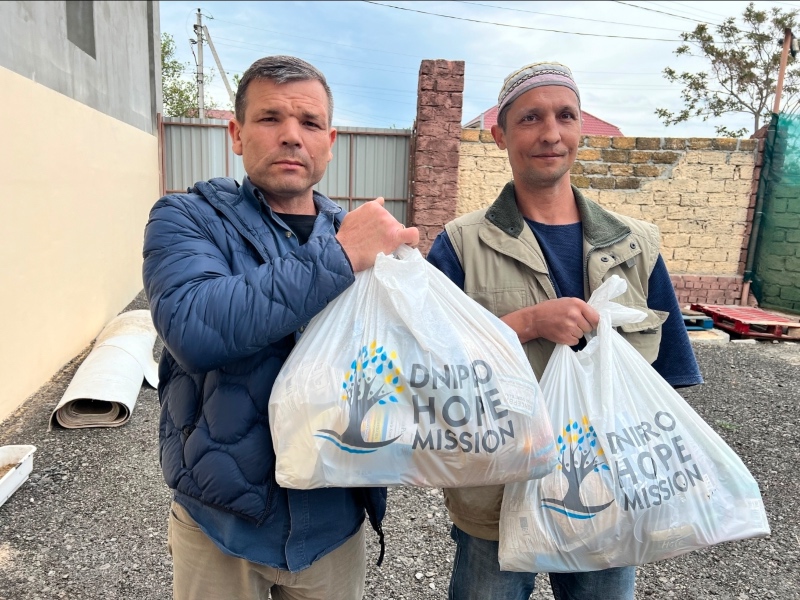
Conclusion: four years on, still standing, still hoping
Four years on, the war continues. The suffering continues. The need continues. But, crucially, so does the hope. Hope in the power of solidarity, but most of all hope in the faithfulness of God, who does not abandon His people in their darkest hour.
Dnipro Hope Mission will continue to be a bearer of that hope that is tangible, practical and life-giving. We will continue to do this for as long as it is needed and as God gives us the strength. We will continue to resist evil through acts of compassion. We will continue to uphold the dignity of every human person. We will continue to bear witness to the Kingdom of God.
We invite you to join us in this work. Not because it is easy. Not because success is guaranteed. But because it is right. Because it is faithful. And because it is what we are called to do.
Four years on, Ukraine is still standing. And so are we, beside them, for as long as it takes.
Prof. Dr. Joshua T. Searle is founding trustee and DHM chair between 2016 and 2022
Dnipro Hope Mission is a registered charity (no. 1177504) working to provide humanitarian assistance to vulnerable people in Ukraine.
To learn more or to support the work, visit dniprohopemission.org. Donations directly fund food, water, medical supplies, shelter and other life-saving assistance to those directly affected by the war.
Do you have a view? Share your thoughts via our contact form
Baptist Times, 24/02/2026