‘Using hunger to change behaviour?’
Some of the flaws of Universal Credit were shared at the Baptist Assembly - alongside ways churches can positively respond to struggling claimants and challenge the system’s injustices
 The session on Saturday afternoon was part of the Enabling Baptist Voices and Action in the Public Square series, and aimed to help churches understand the system. It is likely that many of our churches will have congregation members on Universal Credit, and are already seeing first hand the problems it has been causing.
The session was led by Public Issues Enabler Beth Allison-Glenny, the Baptist member of the Joint Public Issues Team (JPIT).
Universal Credit aims to simplify the benefits system by merging six benefits into one, and is gradually being rolled across the country. For several years JPIT has been advocating we should monitor hunger as a marker of poverty, and Beth explained there is an increase in foodbank use in areas where Universal Credit has been rolled out (according to the Trussell Trust).
There are several contributory factors, including:
-
delays in payments;
-
differing payments each month and little time to prepare means it's impossible to budget in this system;
-
the digital-only application process is complicated, even for those who are IT-literate;
-
it is paid into one household account (it assumes a trustworthy partner but this is not always the case);
-
problems with prescriptions
-
Housing benefit - Universal Credit includes housing benefit, and this has caused numerous issues: it is currently taking nine months to fix missed payments to social landlords, and it doesn’t cover complete cost of rent for many in privately rented housing.
Universal Credit is also failing in other ways. Beth explained that one of its aims was to encourage people into work: Universal Credit was birthed from an idea that welfare was too generous, and a sense that people who choose not to work were ‘morally repugnant’. This development meant that the welfare state ‘ceased to be a safety net' and became a ‘moral dilemma’.
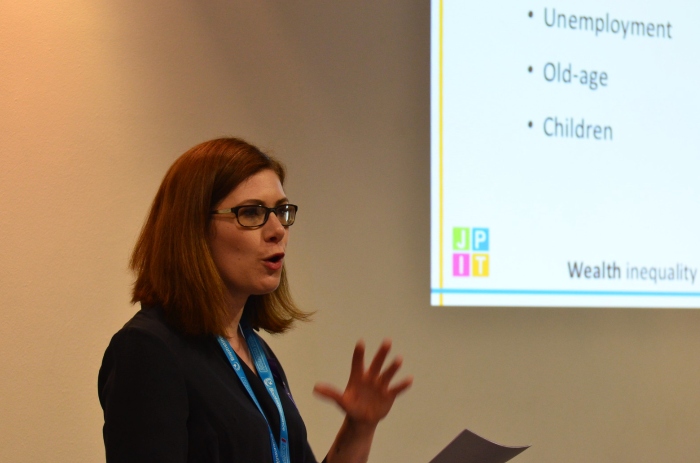 However, Beth (pictured) said that it doesn’t fulfil its own objectives. There is little evidence to show it is bringing more people into work. In reality only a small number of claimants are unemployed (and 70 per cent of children in poverty are in working families).
This points to a key underlying reason why Universal Credit is causing problems: it assumes work is synonymous with less poverty. However 'the real problem is that low paid work doesn’t cover living costs'. Universal Credit doesn’t make work pay, Beth said. 'Our real concern is that poverty is in working families.’
Given the other problems cited, it shows the system ‘is using hunger to change behaviour’. This is a key reason why theologically churches should be engaged with the issue: ‘We believe unconditional love is fundamental to the gospel. God does not love us because of what we’ve done. Penalising people to change is entirely the wrong way round.’
There is a gender dimension too, because Universal Credit adversely affects lone single parents – and the vast majority of single parents are women. Beth shared a quote from the United Nations: ‘There is such a gender dimension to these welfare reforms that if you got a group of misogynists in a room and said how can we make this system work for men and not for women they would not have come up with too many ideas that are not already in place.’
Hannah Brown, the JPIT intern for 2018-19 (and from September JPIT's Campaigns and Church Engagement Officer), explored some of the ways in which the situation could be improved. One solution is to have the right people in the room – ‘people with lived-in experience of poverty’. Such agencies could shape policy that relates directly to people’s experiences.
She explained that JPIT has been involved with Poverty Truth Commissions, which are having an impact. Churches could help by linking people affected by Universal Credit with ‘brilliant local initiatives’ – such as the local Citizens Advice, and if there’s one in their area, a Christians Against Poverty debt centre. JPIT also always advocates for getting to know your local MP.
One very practical way churches can help is by helping people fill out a Universal Credit application. The process is complicated, and supporting people who may not have a computer or be particularly IT literate when they’re making that claim 'is really important'.
Feedback from delegates was shared, including people's first hand difficulties with the system. One church minister mentioned how his church had given financial support to people waiting for Universal Credit payments - and wondered how widespread this was. Could figures be collated to show the Government how much churches were spending on supporting people affected by Universal Credit?
Baptist Times, 20/05/2019