'New insights into how people find faith can help discipleship'
Reports showing how specific demographics find faith in Jesus have been released by the Evangelical Alliance (EA)
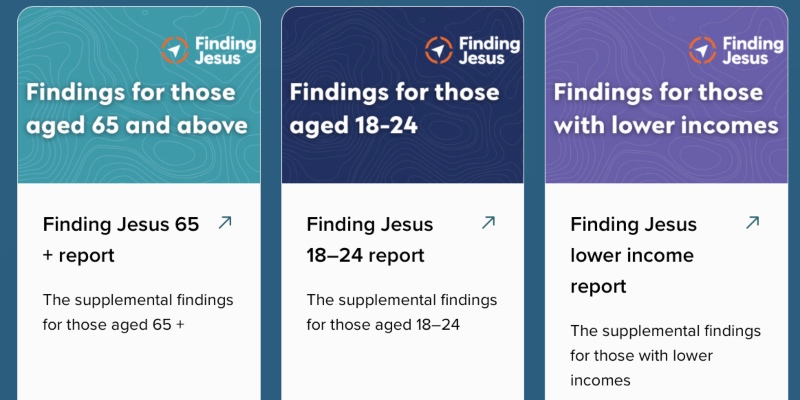
The reports are supplemental studies to the EA's Finding Jesus report (released in 2025), which analysed how adults in the UK are coming to Christian faith.
The supplemental reports go deeper into four specific demographics: people aged 18–24 years old; people aged over 65s; those on lower incomes; and those from a non-Christian background. They highlight key areas around what first prompted them to become Christians, the challenges they faced, who helped them on their faith journey and life since. A fifth report compares male and female responses.
Project lead Rachael Heffer said, 'These five supplemental reports are a great tool for church and ministry leaders to better understand those coming to faith in their church and provide insight into how they can be discipled more effectively.'
The reports acknowledge that 'every journey to faith in Jesus is unique.'
'People’s backgrounds, life experiences and myriad other factors shape the ways in which they and God interact,' the EA states. 'As the full report makes clear, there is no silver bullet or simple answer to why, how, or when people come to faith in Jesus.'
These were some of the observations in each group:
18-24 year olds
The supplemental report indicates that 18-24 year olds, despite exhibiting spiritual curiosity, find their journey to faith 'the most challenging due to a cultural gap between Christian and secular worldviews'. Key findings include 55 per cent of this age group describe their path as challenging, they are most likely to explore faith by talking to Christian friends or family, and they are significantly more likely to use YouTube to research Christianity.
The report also notes a trend of powerful dreams or 'experiences of God' influencing their decisions, and more young men than women are currently being drawn to Christianity, mirroring observations in the Quiet Revival report.
The report also stated it was striking that 'the hospitality, generosity or service of Christians' was cited by 51 per cent (compared to 38 per cent overall).
'Despite their scepticism, when Christians are warm and generous, offer community and live out their faith, young adults are impressed by that authenticity,' the report stated. 'Having grown up cynical of leadership and institutions, in a world of fake news, influencers and abuses of power, Gen Z are hungry for people who are sincere in wanting to live out the gospel of Jesus by blessing others.
'One participant explained, “A lady from church really demonstrated living out the Christian life in a way that was so joyful and hopeful. She left a real impact on me through her generosity by offering me some counselling and by her interest in my life.”
'Another summed up, “The church leader allowed me to ask any questions I had, introduced me to the church community, and welcomed me into his family as an ‘extended member’.”
'Time, hospitality and sacrificial generosity communicate powerfully to sceptical young adults.'
Read the 18-24s report here.
Those aged 65+
The over 65s were significantly more likely than other groups ‘to struggle to understand the relevance of Jesus to their lives,’ stated the report.
'This might be a response to their earlier experiences of church which ‘inoculated’ them against understanding the real significance of the gospel. Equally, having lived most of their adult life without Jesus, perhaps seeing the point in changing now is hard.
'It is well documented that people typically become more resistant to change as they age, and making the decision to follow Jesus is a dramatic shift which involves reconsidering their entire life.
'This might well impact the way we choose to communicate the gospel to older people. What does Jesus mean to, have for, and ask of them in this later life stage?'
Read the over 65s report here.
Those with lower incomes
This group of people (whose household income is less than £20,000) is diverse but 'showed higher levels of general spirituality', said the report. Asked to describe their beliefs before they decided to follow Jesus, 40 per cent of these participants were open to spiritual matters before exploring Christianity, although they didn’t specify what that might mean.
'It seems likely that some were refugees or asylum seekers or from other countries, but the current resurgence in spiritualism, mediums and online spirituality (eg ‘manifesting’, ‘WitchTok’ etc) may also play a part in their responses.'
They also tended to have less historic contact with Christianity than other groups. Only a fifth had Christian parents (compared to a third of the wider sample).
Read the findings for those with lower incomes here
No Christian background
With the growing cultural trend of people identifying as “nones,” the EA was especially keen to understand the faith journeys of those with no Christian background at all — no Christian family members, church attendance, Sunday school, or Christian friends. This group made up a fifth of participants (59 people).
Around a third were from ethnic minority backgrounds, and eight had come to faith in Jesus from other religions. These 31 women and 26 men shared no prior contact with Christians, Christianity, or the church. It included very few of those over 55.
While not true for everyone, the majority came to faith quickly, 74 per cent reporting it had taken them a year or less to make a decision to follow Jesus once they started exploring Christian faith. It seems likely that rather than having to unpick a lot – as older participants had to – they were coming to the gospel with fresh eyes and quite quickly decided they believed in the claims of Jesus.
In describing their faith journey, these new believers with no Christian background were often 'more positive' than other groups, the report stated.
'Of course there were things that were “challenging” (37per cent) but the trend appeared to be that this ‘new news’ was good news to them. Of course, these are people who have decided to follow Jesus, and undoubtedly there are those for whom the gospel did not feel like good news and who have not done so.
'But, in our familiarity with it, we should not forget to express the hope, comfort and life Jesus offers, particularly in challenging times and circumstances.'
Read the report for those with no Christian background here
To access the Finding Jesus report, visit: eauk.org/resources/our-resources/reports/finding-jesus
The five new supplemental reports can all be accessed from the Finding Jesus report page.
Related
'Explore how people are coming to faith today - and how the church can respond'
Andy Glover shares details of upcoming Fresh Streams Equipping Days, which dive into the recent Finding Jesus research from the Evangelical Alliance.
They are taking place on:
-
19 March at Kings Cross Baptist Church
-
15 April at Tarporley Chapel, Cheshire
-
21 May at Shirley Baptist Church, Solihull
Baptist Times, 16/02/2026